
Draping Method for Surgical Area
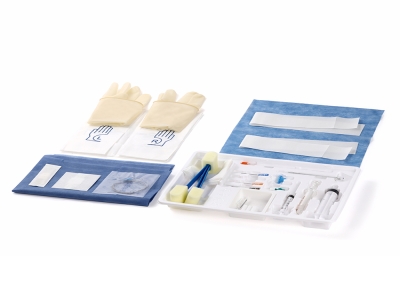
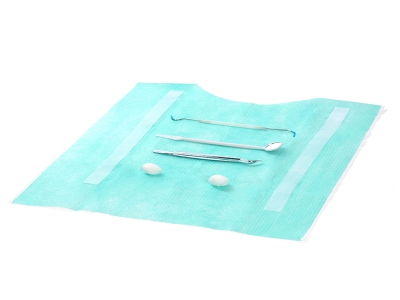
After disinfecting the skin of the surgical area, sterile drapes are applied. The purpose is to establish a sterile safety zone, expose the minimum skin area necessary for the surgical incision, and cover the rest to avoid and reduce intraoperative contamination. The principle of draping is that, except for the surgical area, the surrounding area should be covered with 4-6 layers of sterile drapes, and the peripheral area should have at least 2 layers. Taking abdominal surgery as an example, the following 3 types of drapes/towels are generally applied:
1. Applying Sterile Towels (Incision
Towels)
This step involves covering the area around
the incision with 4 sterile towels.
- The draping person stands on the right side of the patient.
After confirming the incision, they first place 4 sterile treatment towels
around the incision. The side of each towel near the incision is folded
back by 1/4, with the folded part facing downward.
- The scrub nurse folds the edge of each sterile towel by 1/3.
For the 1st to 3rd sterile towels, the folded edge faces the draping
person; for the 4th towel, the folded edge faces the scrub nurse
themselves. The nurse then passes the towels to the draping person in
sequence.
- The draping person places the 1st treatment towel on the lower part
of the surgical area, then places the remaining towels in sequence on the
upper part, opposite side, and same side of the surgical area. The inner
edge of each towel should be within 3 cm of the incision line. Once
placed, sterile towels cannot be moved arbitrarily; if movement is
necessary, they can only be moved outward from the incision.
- After the 4 treatment towels are placed crosswise over the
surgical area, they are secured with 4 towel clamps. When using towel
clamps, avoid clamping the skin and prevent the clamps from tilting
upward.
2. Applying Surgical Medium Drapes
The draping person and the scrub nurse
stand on both sides of the operating table respectively. The scrub nurse passes
the medium drapes, and the two people place two sterile medium drapes on the
upper and lower parts of the incision respectively. The drape on the head side
extends beyond the anesthesia screen, and the one on the foot side extends
beyond the operating table. The draping person must avoid touching unsterilized
items with their hands.
3. Applying Surgical Hole Drape
(Laparotomy Drape)
After applying the medium drapes, the
draping person should soak their hands in disinfectant for 3 minutes or wipe
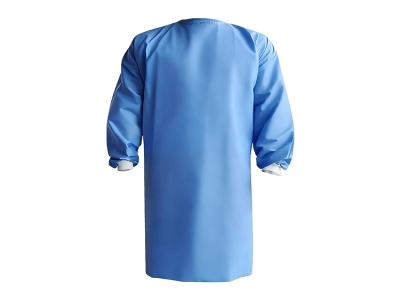
their arms with a povidone-iodine preparation. They then put on a sterile
surgical gown and sterile gloves.
Finally, a perforated laparotomy drape is
applied. Align the opening of the drape with the incision site, with the short
end toward the patient’s head and the long end toward the lower limbs. First
unfold and place the upper end to cover the patient’s head and the anesthesia
screen, hold the upper part in place, then unfold and place the lower end to
cover the instrument tray and the patient’s foot end. The sides and foot end of
the drape should hang down more than 30 cm below the edge of the operating
table.
Precautions for Surgical Area Draping
- For major surgery, place a transverse medium drape on the side
of the anesthesia table.
- If a subcostal incision is required, place a double-folded
medium drape under the patient’s lower back on the affected side before
applying the 4 treatment towels. If an abdominal transverse incision is
required, place a double-folded medium drape on each side.
- When applying drapes, only touch the edges and corners of the
surgical drapes; avoid touching the part of the sterile drapes around the
surgical incision. When applying medium or large drapes, grasp the corner
of the drape and roll it inward to cover the back of the hand, preventing
the hands from touching surrounding contaminated items (such as the
anesthesia screen or infusion tubes) and becoming contaminated.
- To prevent the draping person from touching the part of the
drapes around the incision when locating the corners of the laparotomy
drape, the draping person leaves after applying the small surgical drapes.
Generally, the placement of the large surgical drape is performed by the
surgeon or other assistants after they have put on sterile surgical gowns
and gloves.