
Regulatory Briefing · 7 November 2026 · 6 min read
By the Quality & Regulatory Team, JIANDA Medical | Jining, Shandong, China
For most of the last decade, “ISO 13485 certified” was a line on a supplier questionnaire. Buyers ticked the box and moved on. From February this year, that box carries legal weight in the United States, and it is worth knowing what you are looking at before you sign off on the next one.
On 2 February 2026, the FDA's Quality Management System Regulation (QMSR) took effect. It replaces the old QS Regulation and writes ISO 13485:2016 directly into US device requirements. The EU added its own change on 28 May 2026, when EUDAMED registration became mandatory, and PFAS rules affecting nonwoven fabrics have advanced this year too. Each of these lands on the same piece of paper: the certificate your supplier sends you. What follows is a working guide to reading one properly.
|
2 Feb 2026 FDA QMSR in force. ISO 13485:2016 incorporated by reference. |
28 May 2026 EUDAMED UDI/Device registration becomes mandatory. |
2027 / 2028 Legacy MDR transition periods close at the end of each year. |
What actually changed on 2 February
Before February, a manufacturer selling into America followed 21 CFR 820 and held a separate ISO certificate, mainly because European and Asian buyers asked for one. The QMSR merges the two. The FDA now incorporates ISO 13485:2016 by reference, has retired QSIT in favour of Compliance Program 7382.850, and expects risk management across the product lifecycle, not only in design.
For buyers, one practical point follows. One quality system now serves the US and the EU, so the edition on a certificate tells you which regulatory generation a factory operates in, and how ready it is likely to be for an inspection. Your own supplier-control duty stays where it was; collecting the PDF does not move it.
Seven checks, in this order
In our experience, forged certificates are rare. The usual problem is a mismatch: a perfectly valid certificate attached to the wrong site, the wrong product or the wrong legal entity. The seven checks below catch most of these.
1 Is the issuing body accredited?
Check who accredited the certification body itself. National marks such as UKAS, RvA, DAkkS, ANAB or CNAS mean the issuer is audited in turn. A “registration” from an unaccredited registry may look fine framed on a wall, but it carries no weight in an audit.
2 Look the number up yourself
Every credible body publishes a client directory. Search the number on the issuer's own site and confirm the legal name, site and scope match the PDF you were sent. If it returns nothing, ask the supplier why.
3 Match the site address to the shipping address
Certificates are site-specific. The mismatches we see most often: a head-office address instead of the factory, a parent company's certificate presented by the seller, or a plant the supplier vacated years ago. In each case the certificate does not cover your order.
4 Read the scope sentence — all of it
“Manufacture of medical devices” is too broad to be useful. Your category should be named in the scope: surgical gowns, drapes, packs. If you buy sterile, the word sterile must appear. A non-sterile scope on a sterile product is the most common gap we find in tender packs.
5 Check the edition — and whether “EN” is on it
ISO 13485:2016 is the current edition. A certificate citing the 2003 edition is out of date, whatever its expiry says. If you sell into Europe, the certificate should also carry EN ISO 13485:2016, which is the version your Notified Body will reference.
6 Read three dates, not one
Original registration, latest issue, expiry. A three-year cycle with annual surveillance audits is normal. A recent reissue usually has a reason behind it: a new site, a widened scope or a change of certification body. It costs nothing to ask what it was.
7 Know what it does not cover
A QMS certificate is not a CE certificate, an FDA clearance or a 510(k), and it says nothing about barrier performance to AAMI PB70 or EN 13795. Those come from test reports and a Declaration of Conformity. Ask for each document separately.
The same seven checks, applied to one document
We ran the seven checks on the certificate that covers our own production site in Jining. Here is what came out of each one.
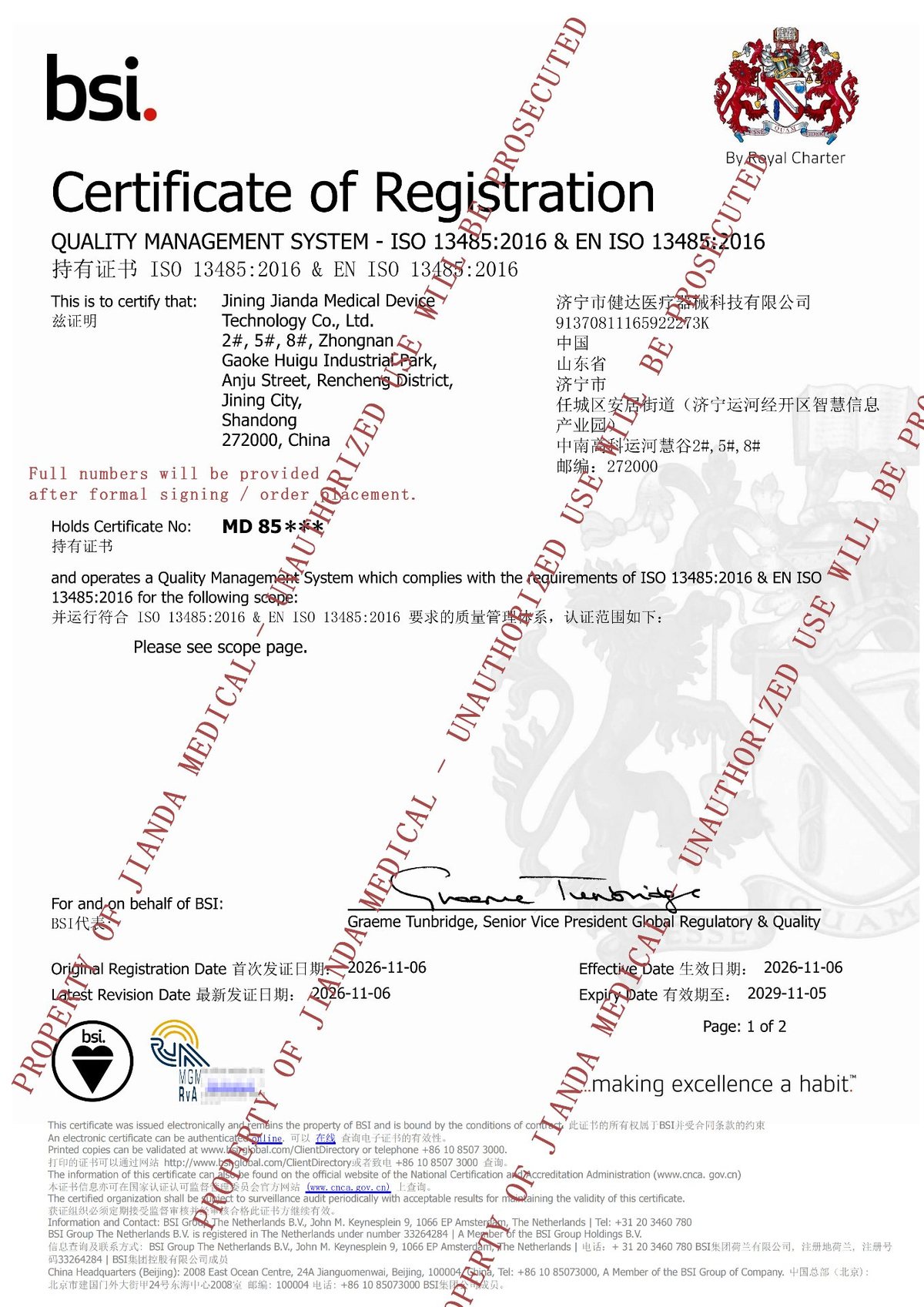
| 1. Issuing body | BSI Assurance UK Ltd, the certification arm of BSI. BSI is the UK's national standards body, founded in 1901, and an accredited ISO 13485 certification body. |
| 2. Certificate number | Withheld in this copy, as the certificate itself notes. A number lifted off a public web page tends to surface in other people's tender documents, so the full number is released on formal signing or order placement. Until then the entry can still be checked in BSI's client directory by company name. |
| 3. Certified site | Jining Jianda Medical Device Technology Co., Ltd. — Workshops 2, 5 and 8, Zhongnan Gaoke Huigu Industrial Park, Anju Street, Rencheng District, Jining, Shandong 272000, China. |
| 4. Scope | Design, development, manufacture and distribution of disposable sterile surgical kits, sterile and non-sterile surgical gowns, drapes, caps, masks, adhesive wound dressings, protective garments, isolation gowns and shoe covers — compressed for readability; the certificate lists each family separately. |
| 5. Standard | ISO 13485:2016 and EN ISO 13485:2016. |
| 6. Dates | Effective 6 November 2026, expiring 5 November 2029. The site has held ISO 13485 certification since 1 November 2023, first under GB/T 42061-2022, the Chinese adoption of the same standard. |
| 7. What it excludes | Everything in check 7 — it is a QMS certificate, not product approval. |
Two lines on this certificate do more work than they first appear to. “Design, development, manufacture and distribution” means we can run a construction change on our own; a converter without design in scope has to send every revision back to you for re-validation. The site line, Workshops 2, 5 and 8, matters because certificates are issued against a floor plan. If a workshop is added, the scope has to be extended before product from it carries the mark.
A certificate does not have to be impressive. It has to be checkable, and checking is what an audit is made of.
JIANDA in practice
Our quality system was first certified in November 2023 and re-certified under BSI in November 2026. We chose BSI for a practical reason: buyer quality teams can verify a BSI certificate in the issuer's own client directory within minutes, which means fewer emails for them and fewer duplicate questions for us.
The documents the certificate promises
A QMS certificate says the factory has a system for producing these documents and keeping them current. It does not hand them to you. In 2026 a complete pack for disposable surgical consumables looks like this:
| Document | Standard / basis | What “good” looks like |
|---|---|---|
| Sterilization validation | ISO 11135 · 11137 · 17665 | Overkill data, plus EO residual limits to ISO 10993-7. |
| Sterile barrier system | ISO 11607-1/-2 · EN 868 | Seal strength and integrity after accelerated ageing, not a visual check. |
| Barrier performance | AAMI PB70 · EN 13795-1 | A stated level, with a report naming the critical zone construction. |
| Material declaration | Fibre + finish chemistry | Names the repellent chemistry used. “Eco-friendly” is not a declaration. |
| EU market entry | MDR 2017/745 · EUDAMED | DoC, SRN and UDI-DI you can check in the database yourself. |
Of the five, the material declaration is the document we would chase first. Fluorinated finishes have long given nonwoven gowns and drapes their fluid repellency, and they are also the reason the category now faces a regulatory question: ECHA's universal PFAS restriction under REACH is moving toward final opinions through 2026, and several US states already restrict intentionally added PFAS in textile articles. Medical devices may win derogations, but a buyer who cannot document the chemistry in a gown is exposed either way. If your supplier cannot tell you which repellent finish is on the fabric, they cannot tell you whether that product will still be sellable in 2028. Ask for the declaration in writing, for the specific construction you are buying.
JIANDA in practice
We put the finish in writing for every construction we sell, including when it is a conventional fluorinated repellent. Vague answers here cost our customers time in their own audits, so we stopped giving them.
Four dates to put in your contract calendar
- 28 November 2026 — the transition for registering devices already on the EU market closes.
- 28 May 2027 — MDR certificates must be registered in EUDAMED.
- 31 December 2027 — the extended MDR transition ends for Class III and Class IIb implantables.
- 31 December 2028 — and for the rest of the legacy portfolio, including Class IIa and Class I sterile devices.
Gowns, drapes and procedure packs mostly fall into the 2028 bracket, so the deadline still feels a long way off. From the factory side it is not. Re-certification has to be finished well before the date, and factories are already working through Notified Body queues, so booking capacity for custom packs early will cost less than trying to negotiate it in 2028.
What a certificate is actually for
A certificate is only as good as the checks behind it. The seven above are the ones we expect our own customers to run on us, and the ones we run on raw-material suppliers before we sign with them.
If you are still shortlisting, the related reads are our six-gate guide to qualifying a second source, the specifications behind our disposable sterile surgical gowns and universal surgical packs, and the in-house laboratory where the testing is done. Questions can go to our export team through the contact page.
Primary sources
U.S. Food & Drug Administration — Quality Management System Regulation (QMSR); final rule, 21 CFR Part 820.
European Commission — EUDAMED rollout and transition periods; MDR transition timelines under Regulation (EU) 2023/607.
European Chemicals Agency — universal PFAS restriction proposal.
ISO — ISO 13485:2016, Medical devices — Quality management systems — Requirements for regulatory purposes.