
Why Medical Caps Are the Final Line of Defense for Operating Room Cleanliness?
1. Hair: The Underestimated "Bacterial Petri Dish"
Hair itself does not generate bacteria, but it traps airborne dust, and the oils and sweat secreted by follicles are ideal nutrients for bacterial growth. Even more dangerous is the shedding of Skin Scales.
Particle Release: When medical staff move their heads or create friction, dried skin flakes laden with bacteria fall like snowflakes from the hair. If the medical cap lacks sufficient barrier performance, these particles penetrate the fabric and settle onto sterile instrument tables or patient incisions via airflow.
Source of Cross-Contamination: This invisible "particle rain" is often the culprit behind unexplained post-operative infections or failures in precision instrument manufacturing.
2. Material Selection: The Logic of SBPP Non-Woven Fabric
Traditional cotton caps suffer from "self-linting" (cotton fibers shedding themselves) and have largely been phased out. Modern medical caps (such as those from
Low Linting: SBPP fibers are long and tough, generating almost no dust themselves, meeting ISO cleanroom standards.
Breathability-Filtration Balance: The unique fibrous web structure allows heat to escape, preventing scalp sweating (humidity accelerates bacterial growth), while effectively intercepting skin particles larger than specific pore sizes, achieving a "breathable yet dust-proof" effect.
3. Structural Design: Bouffant vs. Clip Cap Scenarios
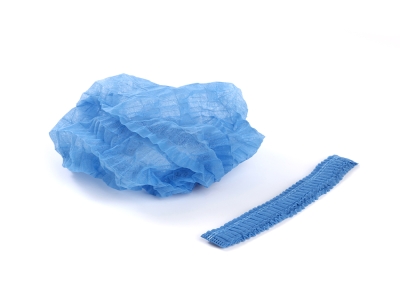
Medical caps are typically categorized into Bouffant Caps and Clip Caps (Mob Caps), each with specific design intentions:
Containment: Premium bouffant caps are designed with sufficient "puffiness" to completely encapsulate the hair, even for staff with long hair, leaving no strands exposed. This is key to achieving "Zero Exposure."
Sealing: The elastic band (single or double) at the rim is crucial. It must possess excellent resilience to fit tightly against the forehead and nape, preventing Edge Leakage of particles, without being so tight that it causes indentation or discomfort.
4. Comfort and Compliance: The Behavioral Link
Why do some surgeons unconsciously touch their caps during procedures? Usually, it is due to heat or itching.
Touch Equals Contamination: Once a sterile gloved hand touches the non-sterile head, the sterile chain is broken.
Comfort Equals Safety: Jining Jianda Medical selects soft, skin-friendly non-woven fabrics to minimize scalp irritation. A comfortable cap reduces the frequency of staff adjusting their headgear, indirectly maintaining the sterile protocol of the surgical process.
Conclusion
In the chain of sterility control, the Disposable Medical Cap sits at the very top. Though light as a feather, its impact is massive. It locks down the body's most active source of particle emission—the head—safeguarding the purity of the clean environment. For healthcare institutions striving for ultimate cleanliness management, choosing a low-linting, high-barrier, and comfortable medical cap is the most cost-effective investment in bio-contamination control.